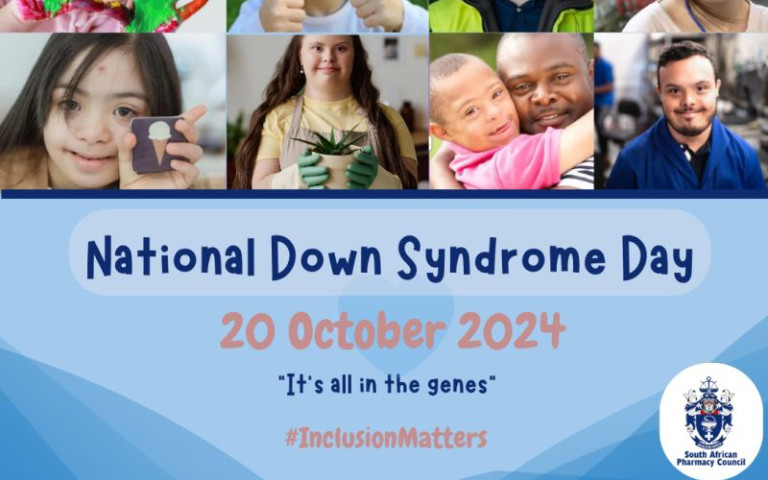
National Down Syndrome Day is commemorated to raise awareness about Down Syndrome and to share important facts about the condition. The theme for this year is “It’s all in the genes”.
What is Down syndrome?
Down syndrome is a chromosomal disorder that occurs at conception, characterised by an extra copy of the 21st chromosome (Trisomy 21). This extra chromosome can lead to delays in physical and intellectual development. Babies with Down Syndrome do look slightly different from other babies and therefore, they can usually be identified at birth.
Some of the typical features include:
• Small low-set ears
• A single crease on the palm of the hand
• Short hands and fingers
• Inclining pinkie
• Eyes that slant upwards
• Tiny folds covering the inner corners of the eyes (epicanthic folds)
• Small white flecks on the iris (Brushfield spots)
• Wider gap between the big toe and second toe
• A small nose with a broad, flat bridge
• A small mouth that makes the tongue appear large
Here are some of the myths that still exist about Down Syndrome and those who have it today:
5 Myths about people living with Down Syndrome
Down syndrome is a rare disorder.
• Down syndrome is hereditary and runs in families.
• Most children with Down Syndrome are born to older parents.
• Parents will not find community support in bringing up their child with Down Syndrome.
• All persons with Down Syndrome have a severe cognitive disability.
5 Truthful facts about people living with Down Syndrome
Down Syndrome is the most commonly occurring chromosomal condition.
• Translocation, a type of Down syndrome that accounts for 3 to 4% of all cases, is the only type of Down Syndrome known to have a hereditary component. Of those, one-third (or 1% of all cases of Down Syndrome) are hereditary.
• Most children with Down Syndrome are born to women younger than 35 years old simply because younger women have more children. However, the likelihood of having a child with Down syndrome increases with the age of the mother, especially after age 35.
• There are provincial support groups and other community organisations directly involved in providing services to families of individuals with Down Syndrome.
• Most persons with Down Syndrome have a mild to moderate cognitive disability, or intellectual disability.
This is not indicative of the many strengths and talents that each individual possesses. Be considerate of the extra time it might take a person who has a disability to get things done or said.
Sources
1. What is Down Syndrome, Down Syndrome South African, https://lnkd.in/dPrT_4n9
2. Myths and Truth, Down Syndrome South African, https://lnkd.in/dn7maakZ